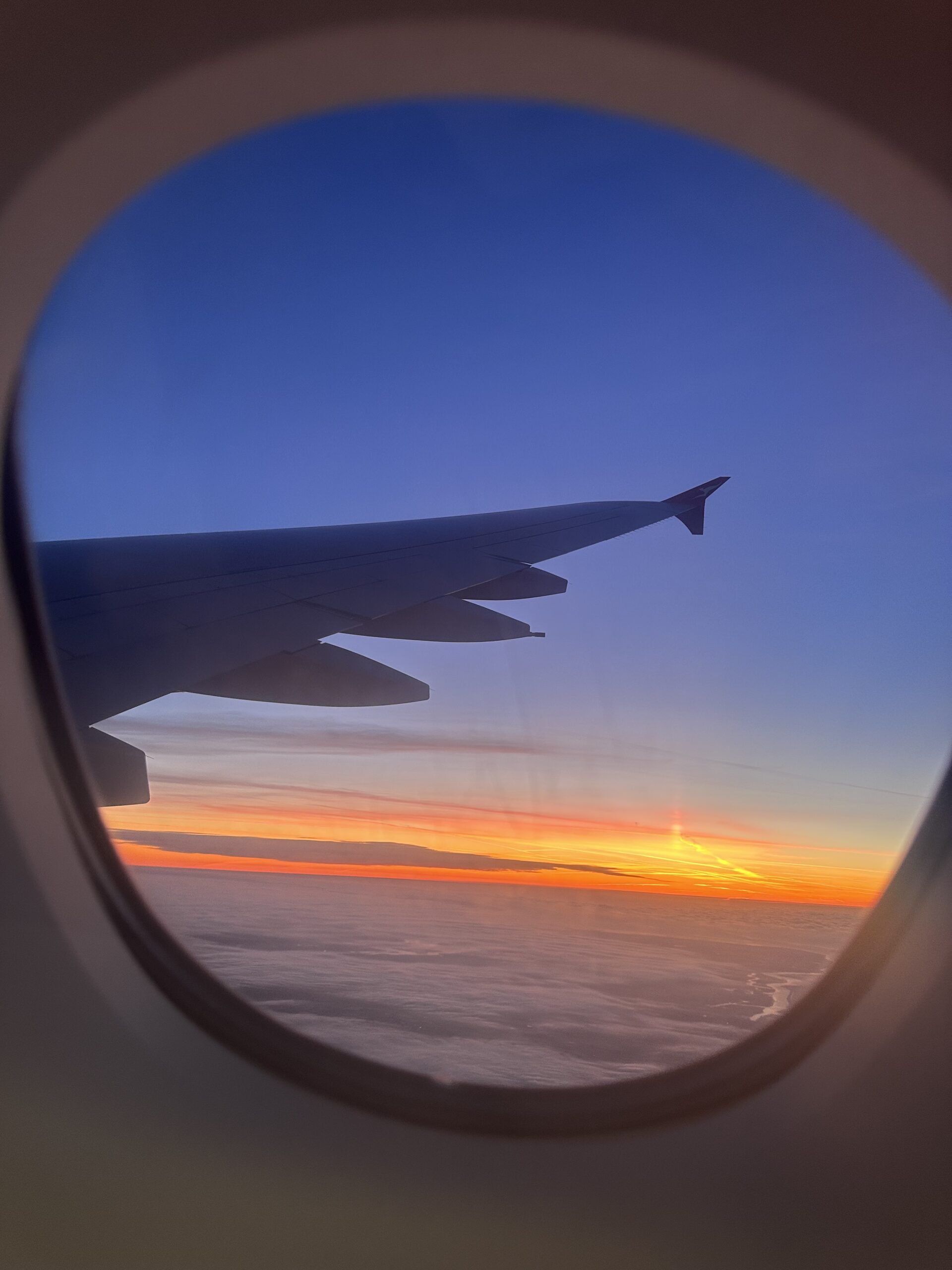
If you’ve sat next to me on a flight lately, you’ve probably watched me hydrating somewhere over the Nullarbor and wondered what I was doing. Between client work, my science work, and the odd weekend away, I’m in and out of airports more than I used to be, and a few trips in, I noticed a pattern. I’d land feeling flat, foggy, and tight-skinned, no matter how well the trip itself had gone.
So I did what I always do: I went looking for the science. It turns out “travel skin” and “travel fatigue” are both real, measurable things — and both are things you can actively work with, not just something to accept as the cost of getting on a plane. This is the routine I’ve built for myself, backed by the research behind it.
A quick note before we start: I’m sharing my personal routine, including the Arbonne products I reach for, because they’re genuinely what’s in my bag — not because I’m telling you they’re the only option. And because part of this post touches on nutrition and supplements, please remember I’m not able to give individual medical advice here. If you have a health condition, take medication, or are pregnant or breastfeeding, check with your GP or an accredited dietitian before changing your supplement routine, especially before travel.
Strong Body: Why You Land Feeling Flat (and What Actually Helps)
Two things are working against your energy the moment you board: dehydration and disrupted nutrition timing. Neither is dramatic on its own, but they compound over a long-haul or even a domestic red-eye.
Hydration is doing more than you think. Research on mild dehydration — the kind you don’t even notice as thirst — has repeatedly shown it can affect mood and cognitive performance in healthy adults, showing up as a foggier head and a flatter mood rather than obvious physical symptoms, a finding echoed across multiple controlled studies on mild dehydration and mood in healthy adults. A separate controlled trial specifically found mild dehydration was associated with a decline in vigour and an increase in fatigue, confusion, and tension in healthy young women — a strikingly familiar description of how a lot of us feel by the time we’ve cleared customs. On the flip side, rehydrating after a period of fluid restriction reliably improves fatigue, mood, and short-term performance measures. My practical version of this: a large water bottle I refill after security, and I treat the “one glass of water per hour in the air” rule as a genuine non-negotiable, not a suggestion.
Your energy metabolism needs its raw materials. B vitamins (B1, B2, B3, B6, B9, and B12) play a well-established role in the biochemical pathways that convert food into usable cellular energy, and a narrative review of the clinical evidence links inadequate B vitamin status to worsened fatigue and impaired cognitive performance. A separate randomised, double-blind trial in healthy adults found that B-complex supplementation measurably improved markers of fatigue. This is exactly why my travel-day habit is a stick of my Arbonne Energy Fizz Sticks dissolved into water mid-morning rather than a second coffee — it’s a B-vitamin and antioxidant hit designed to support normal energy metabolism, on top of the hydration I’m already prioritising, rather than a stimulant spike I’ll crash from over a long transit day.
A note on the science-to-practice gap: none of this research is about jet lag itself (your circadian rhythm resetting to a new time zone) — that’s a separate process governed mostly by light exposure and sleep timing. What hydration and B-vitamin status appear to influence is travel fatigue: the flat, foggy, low-energy feeling that can show up on a two-hour domestic flight just as easily as a long-haul one. That distinction matters, because it means there’s genuinely something practical you can do about it, starting today.
A gentle disclaimer: the above reflects general nutrition science and my own routine — it isn’t personalised medical or dietetic advice. Please check with your GP or an accredited dietitian before starting any new supplement, particularly if you’re managing a health condition or travelling with additional health considerations.
Glowing Skin: What Cabin Air Is Actually Doing to Your Face
This is the part of the post I get most animated about, because the mechanism is genuinely fascinating once you understand it.
Cabin air is drier than most deserts. Aircraft cabin humidity typically sits between roughly 10–20%, compared with the 40–60% relative humidity your skin is used to at ground level. That gap matters more than most people realise, because your skin barrier is constantly negotiating a moisture exchange with the air around it — a process called transepidermal water loss (TEWL), where water evaporates from the outer layer of your skin (the stratum corneum) into the surrounding air. In a peer-reviewed study of workers occupationally exposed to ultra-low humidity environments, researchers documented measurable, dose-related changes in skin barrier function with prolonged exposure. A flight is a short, intense version of exactly that environment — and the drier the air, the steeper the moisture gradient pulling water out of your skin.
Altitude adds a pollution layer, too. Separately from humidity, your skin spends its whole life defending itself against environmental oxidative stress — UV exposure, airborne particulate matter, and general pollution all generate reactive oxygen species that degrade collagen and elastin over time and accelerate visible ageing. This is where topical antioxidants earn their keep. A randomised clinical study testing a topical antioxidant serum (containing vitamin C, vitamin E, and ferulic acid) against particulate-matter exposure found it measurably protected skin structural proteins and reduced markers of oxidative stress and inflammation compared with unprotected skin. A related comparative study reached a similar conclusion when testing the same antioxidant combination against both UV and diesel exhaust exposure.
What this means for your actual routine: the two jobs are (1) replace the moisture the cabin air is pulling out, and (2) arm your skin with antioxidants before it meets pollution, screens, and UV at your destination. My in-transit routine is genuinely simple:
- Before boarding: a proper cleanse and an antioxidant serum — I use my Arbonne RE9 Advanced Intensive Renewal Serum, which is formulated with vitamin E and green tea polyphenols, before I get anywhere near the airport, so it’s already working by the time I board.
- Mid-flight: a hydrating mist or a rich moisturiser reapplied once or twice, because you’re topping up against a continuous moisture pull, not treating it once and forgetting it.
- No makeup for long-haul where possible, so nothing is sitting on top of a barrier that’s already working overtime.
- On landing: a proper cleanse before bed that night, whatever the time zone says, so pollution and recycled cabin air aren’t sitting on your skin overnight.
A brief disclosure: the Arbonne products mentioned above are genuinely part of my personal routine and something I’d recommend to clients asking what to pack, not a paid placement. As always, patch-test anything new before travel, and current pricing and availability should be checked directly on Arbonne’s site, since I can’t guarantee sale details are current by the time you’re reading this.
Healthy Mind: Letting Travel Disrupt the Habit, Not the Identity
Here’s the mindset shift that’s made the biggest difference for me: I stopped trying to maintain my full routine while travelling, and started maintaining a much smaller “floor” instead.
Travel will disrupt your workout schedule, your usual meals, and your sleep window — that’s simply true, and fighting it usually just adds guilt on top of tiredness. What seems to matter more for staying consistent long-term is having two or three non-negotiables that travel with you no matter what: for me, that’s the hydration habit above, the skincare bookends (cleanse and serum, morning and night, wherever I am), and five minutes of stillness before I look at my phone in the morning. Everything else — the workout, the “perfect” meals — gets a pass while I’m away, and I pick it back up the day I land, without treating the gap as a failure.
This is the same self-compassion principle I talk about constantly in the Healthy Mind pillar: consistency isn’t about never missing a day, it’s about how quickly and kindly you return to the habit after life gets in the way. Travel is just life getting in the way on a schedule.
Your Travel Wellness Checklist
- Refill a water bottle after security; aim for a glass an hour in the air
- Skip the second coffee mid-flight; try a B-vitamin and antioxidant option like an Energy Fizz Stick instead
- Cleanse and apply an antioxidant serum before you leave for the airport
- Pack a hydrating mist or rich moisturiser for mid-flight reapplication
- Cleanse again on landing, whatever the local time says
- Pick two or three non-negotiables and let the rest flex
Want the full breakdown, including exactly how I sequence my skincare on a long-haul flight? I go deeper on this in this week’s episode of the Strong, Healthy, Glowing Podcast, and I’ll be unpacking it further in this week’s Wellness Edit newsletter.
This article is general information based on published research and my own professional and personal experience. It is not a substitute for individualised medical, dietetic, or dermatological advice. Please consult your GP, dietitian, or dermatologist before changing your nutrition, supplement, or skincare routine.
References
- Chou, T-C., Lin, K-H., Wang, S-M., et al. Transepidermal water loss and skin capacitance alterations among workers in an ultra-low humidity environment. Arch Dermatol Res. 2005;296(10):489–495.
- [Antioxidant serum vs. particulate matter-induced skin oxinflammaging, randomised clinical study] Cosmetics / dermatology journal, 2025.
- [Comparative study of UV and diesel exhaust cutaneous damage and topical antioxidant protection] dermatology journal, 2025.
- Tardy, A-L., Pouteau, E., Marquez, D., Yilmaz, C., Scholey, A. Vitamins and Minerals for Energy, Fatigue and Cognition: A Narrative Review of the Biochemical and Clinical Evidence. Nutrients. 2020;12(1):228.
- Lee, M-C., et al. A functional evaluation of anti-fatigue and exercise performance improvement following vitamin B complex supplementation in healthy humans, a randomised double-blind trial. Int J Med Sci. 2023;20(10):1272–1281.
- Ganio, M.S., Armstrong, L.E., Casa, D.J., et al. Mild dehydration impairs cognitive performance and mood of men. Br J Nutr. 2011;106:1535–1543.
- Armstrong, L.E., Ganio, M.S., Casa, D.J., et al. Mild dehydration affects mood in healthy young women. J Nutr. 2012;142:382–388.
- McCartney, D., Desbrow, B., Irwin, C. The Effect of Fluid Intake Following Dehydration on Subsequent Athletic and Cognitive Performance: a Systematic Review and Meta-analysis. Sports Med Open. 2017;3:13.
- Adan, A. Cognitive performance and dehydration. J Am Coll Nutr. 2012.